Angel Oi Yee Cheng's avatar

The Controversies of Moral, Civic, and National Education in Hong Kong

pic 4
Civic education seems an indispensable element for the citizens in most of the nations. Some countries may refer to it as “Citizenship Education” or “National Education.” According to Branson and Quigley (1998), civic education in a democracy is education to encourage citizens to become actively involved in their own governance. In other words, citizens should have critical mindset and not just passively accept the demands of others.  It includes the study of civic law and civic code, and the study of government with attention to the roles, rights, and duties of citizens in the operation and oversight of government.

Ideally, democracy is fully realized when every member of the political community shares in its governance. Members of the political body are its citizens and membership implies participation. Citizens’ participation in a democratic society must be based on informed, critical reflection, and on the understanding and acceptance of the rights and responsibilities that go with that membership.[1] The goal is to engage citizens to be actively involved in the governance or politics and cultivate their positive attitudes towards their own country.

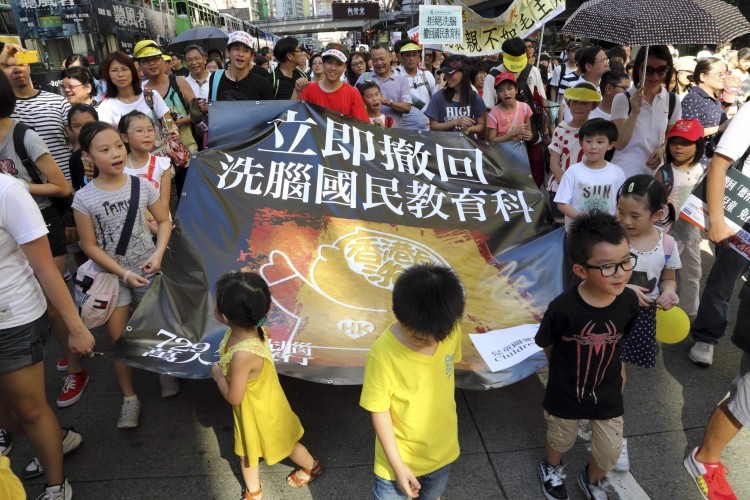
Not surprisingly, the introduction of Moral, Civic, and National Education into Hong Kong’s public school curriculums through Chief Executive Donald Tsang’s “Policy Address 2010-2011” has raised a lot of controversy in the society, especially in the academic arena. The HKSAR Government planned to implement the reform in various stages by initially introducing a new subject in primary schools in 2012 and then in secondary schools in 2013.[2] Notwithstanding a gradual implementation approach, there have been waves of demonstrations by parents, teachers, and students. During the peak day on July 29, 2012, 90,000 people (or 32,000 according to the government’s estimates) went on the streets to demonstrate in super hot and humid weather.[3] The protesters firmly believed that the main political motivation behind Chinese Central Government in Beijing was to use Moral, Civic, and National Education as a tool to “brainwash” the citizens in Hong Kong with its communist ideology. They were afraid that the degree of freedom in this special administrative region would be gradually limited or eventually diminished. The demonstration had even caught international attention through the mass media such as New York Times, NBC, CNN, or BBC news.


pic 1

pic 2


The main reason for this controversy was that people in Hong Kong have been suffering from an identity crisis after a century of British rule. Annually, the University of Hong Kong implements a public survey through Public Opinion Program to keep track of the progress of the citizens’ identity. In the questionnaire, one of the questions directly asks about the self-perception of identity among the people of Hong Kong, with the following multiple choices available as a possible response: “Hong Kong Citizen,” “Chinese Citizen,” “Hong Kong Chinese Citizen,” “Chinese Hong Kong Citizen,” “Other,” “Don’t Know / hard to say,” or “Refuse to answer.”[4] Most of the Hong Kong citizens always distinguish themselves from the Mainland Chinese.

Ironically, most Hong Kong people are actually the early settlers from China. As students during the British colonial era, however, we did not study anything about a national identity associated with China. We can see that education is a powerful socialized tool to influence one’s mind. After handover to the Chinese regime in 1997, we have witnessed a series of ongoing clashes between Hong Kong and Mainland China in political, economic, and cultural aspects. More and more conflicts between these two places have surfaced with the massive coverage of media every day.

In introducing Moral, Civic, and National Education in Hong Kong, different actors played an active role behind the scenes – including the Chinese Central Government, the Hong Kong SAR Government, various political parties, educators, and youth (students) – all with their own interests and agendas. This created a divisive scenario, i.e. Chinese Central Government, the Hong Kong SAR Government, pro-Chinese political parties, educators, and students, on one side, and demonstrators against them, on another side. Some youth put their health at risk by going on hunger strike outside the government headquarters for days and days to illustrate the intensity of their anger, although some critics believed that political parties paid students for going on strike. Later, the hunger strike included teachers, a parent, and even a retired professor.[5] Following the serious resistance and criticism from the broader community, the government finally was willing to delay the introduction of the new school subject by suggesting a three-year trial run period, allowing the schools to start, at the latest, in 2015 after consultation and major amendments of some sensitive terms.[6]


pic 3


Moreover, there have been divergent views towards Moral, Civic, and National Education among the community-at-large and the official website of the Education Bureau of the HKSAR Government. It seemed that Education Bureau of the HKSAR Government has included civic education in a very subtle way. The website says that the new subject could develop students’ ability to analyze and judge issues relating to personal, family, social, national, and global issues at different developmental stages, and increase their motivation to make commitment and contribution. The areas will include current issues, moral education, national education, life education, values education, basic law education, health education, sex education, environmental education, and human rights education.[7] Conversely, the public may believe that it would be chiefly to promote national education and enhance students’ understanding of China and national identity.[8]

This education reform literally reflected how little trust Hong Kong citizens have in the Chinese Central government. It may also show how frightened the next generation is about convergence with the motherland, Mainland China. From my own perspective, this trend is just unavoidable as it is a way for Hong Kong to have a better integration. The influence from China overall will be further intensified in the coming decades. Hong Kong people just cannot deny the fact that we have to depend much on China, particularly in the economic development. At the very least, we have to deal with the influx of increasingly large numbers of Mainland Chinese tourists every day. Hence, we have a saying: “Hong Kong people have dual feelings towards China, both hatred and loving emotions.”


[1] Branson, M.S. & Quigley, C.N. (1998). The Role of Civic Education. George Washington University. Retrieved on April 4, 2014, from http://www.gwu.edu/~ccps/pop_civ.html

[2] Liu, J. (2012, August 31). Hong Kong debates ‘national education’ classes. The BBC. Retrieved on April 4, 2014, from http://www.bbc.com/news/world-asia-china-19407425

[3] Lai, A. (2012, July 30). National education’ raises furor in Hong Kong.  Cable News Network. Retrieved on April 4, 2014, from http://www.cnn.com/2012/07/30/world/asia/hong-kong-national-education-controversy/

[4] University of Hong Kong (2014). Public Opinion Program. Retrieved on April 4, 2014, from http://hkupop.hku.hk/english/popexpress/qre/tp1312075_18.html

[5] Lai, A. (2012, September 4). Hong Kong school year starts hunger strikes.  Cable News Network. Retrieved on April 4, 2014,from http://www.cnn.com/2012/09/04/world/asia/hong-kong-national-education-protests/

[6] Chong & Tam (2012, October 9). Controversial guidelines on national education shelved. South China Morning Post Publishers Ltd. Retrieved on April 4, 2014, from http://www.scmp.com/news/hong-kong/article/1056653/controversial-guidelines-national-education-shelved

[7] Education Bureau of the HKSAR Government (2014). Moral, Civic and National Education. Retrieved on April 4, 2014, from   http://www.edb.gov.hk/en/curriculum-development/4-key-tasks/moral-civic/index.html

[8] International Business Times (2012, September 6). Hong Kong Protestors of National Education Wary of Integration with Mainland China. Retrieved on April 4, 2014, from http://www.ibtimes.com/hong-kong-protesters-national-education-wary-integration-mainland-china-780011

Sarah Glickstein's avatar

Testing within the Special Needs Community

According to the Individuals with Disabilities Education Act (IDEA), every student with special needs is entitled to “free and appropriate education.” This means that every student, regardless of disability, is entitled to receive quality public education in the United States. In practice, however, not every student with special needs is provided with adequate public education. Many times, parents must advocate on behalf of their child’s educational needs, without the support of legislature or policy provision.

The very phrase “special education” evokes conflicting feelings, perspectives, and experiences, making policy discussions on this issue especially sensitive. It is a very hard concept to define, but in an idealistic sense, special ed means that “the individual needs of a student who has a disability are met by the mandate of a legal document known as an Individualized Education Plan, or an IEP.” There is a large achievement gap between special-education students and general-education students, and this gap seems to have been growing over the past few years.

As someone who has grown up with a younger sibling with autism, I am somewhat familiar with the struggles that my parents had to go through in providing my brother with an adequate education. He cannot be mainstreamed, even though that discussion was brought up numerous times by local administrators and legislators. Through numerous battles with our state and township, an agreement was reached to provide my brother with public education at a school for special needs children in another town. This also means that he is provided with free transportation to and from the school, and has access to after school activities and resources.

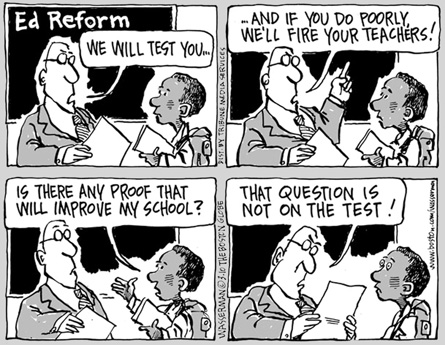
While all of that seems fine and dandy, my parents face constant challenges within the special needs’ education system. To me, it seems that the most highly contested issue is that of standardized testing within the special needs community. As the No Child Left Behind Act made its rounds through the US education system, it also infested special needs public education. Instead of my brother learning basic reading and math skills, he was being given homework on advanced reading comprehension and other test-related concepts. If he and his classmates did not pass these tests, the school would lose funding. My brother was frustrated because he didn’t understand the material, the school was frustrated in not being able to teach practical information, and my family was frustrated in this wasted instruction.

blogs.longwood.edu

blogs.longwood.edu

Not everyone agrees with this “anti-testing” mantra. A teacher who was interviewed by the Huffington Post argues that special needs students should be analyzed with standardized tests because the tests provide data on how students are performing in accordance with “Common Core Standards.” This teacher further claims that special needs schools need this type of statistical information to help future student achievement, and the only way to gather that information is through standardized tests.

Perhaps they would feel differently if they sat down at the dining room table with my brother and tried to help him with his homework.

These assessments for special needs testing have inherent flaws. These tests attempt to generalize statistics for a group of students who are all unique – who all have different socialization and educational needs. By definition, students with special needs need individualized education plans, meaning that their individuality is fundamental to their being, and therefore, fundamental to their success in school. How can we group these individuals together as a cohort to study for future educational change?

Recent lingo on this issue has included “voucher systems,” which would take funds away from public schools and move them to private schools. Earlier this year, Wisconsin Republicans proposed a measure for this type of system, claiming that it would allow children with disabilities to have greater “options” and “flexibility” within the education system. I have a fundamental problem with this system: I believe that a voucher system would put special needs education at risk. IDEA rights may not apply or be enforced as much in private schools, meaning that special needs children in public schools may be at risk.

It is clear that the issue of special education will always be a topic of debate throughout the United States as well as the rest of the world. We must work to preserve every disabled child’s right to quality education. My brother, and the rest of the special needs community, deserves to have quality education as a fundamental right…just like the rest of us.


Alyssa Buccella's avatar

Teacher Status and Student Achievement: A Global Comparison

On the 17th of March, as may as 1,800 teachers across 26 state run upper secondary schools in Iceland have gone on strike. [1] Updates that followed nine days later reported that the strike was still ongoing with no end in sight. [2] The Icelandic Teacher’s Union, Kennarasamband Islands (KI), has cited that teachers earn, on average, 17% less than other university-educated workers in the public sector.  Further, a law was changed in 2008 calling for teachers at all levels to obtain a Masters degree in order to get a teaching license, however teacher’s salaries have not increased as much as those for other professions since 2006.  Teachers are now fighting for better conditions with support from the union, and the president of KI has stated that they will back down until their demands are met. [3]

Interestingly, the Organization for Economic Co-operation and Development (OECD) “warned Iceland that because the salary difference between teachers and other university-level professions is too large, young people are not interested in becoming teachers and choose other professions.” [3] Essentially, the OECD is commenting on the ways in which indicators of teacher status, one of which is monetary compensation, affect how the best and brightest young people are attracted to the teaching profession.  This ultimately has very obvious implications for the quality of education and student achievement.

Speaking further to this issue, in October 2013, the Varkey GEMS Foundation published a study, the 2013 Global Teacher Status Index[4] In the foreword of this report the chairman of the foundation, Sunny Varkey, states that research shows that better paid teachers are associated with greater student outcomes overall.  In 95% of the countries surveyed, survey respondents thought that teachers should be paid more than the salary participants thought teachers currently received; this held true even in Finland, a country that already achieves outstanding results in student achievement. [4] Of note, in the United States, people generally underestimate the salaries that teachers actually make, and teachers generally make more than people deem a fair amount; along with this, 80% of people in the US support performance-related pay for teachers, which was an overwhelming trend in the study overall. [4] While Varkey supports governments increasing the pay and working conditions for teachers as a whole as a way to increase their status, he acknowledges that this is not all it will take to add to the cultural value placed on teachers in various contexts. [4]

A rather interesting case for examining this distinction is that of China.  Out of 21 countries surveyed, China was the only country in which people saw teachers as having equal status as doctors, in contrast to less than 5% feeling this way in the UK. [4] Further, while 50% of parents in China would encourage their children to become teachers, a mere 8% of parents in Israel would do so, with very similar numbers in Brazil, Japan, and Portugal. [4] While those conducting this study recognized many elements that could be included under the umbrella of “teacher status”, they utilized four such elements to create an index score that ranked countries on a scale of 1 (low status) to 100 (high status): ranking status for primary teachers, secondary teachers and head teachers against other key professions; analyzing the aspiration of teaching as a ‘sought’ profession; creating a contextual understanding of teachers’ social status; and examining views on pupil respect for teachers. [4]

China received an index score of 100 and more respondents were likely to believe that students respect their teachers.  Conversely, in most European countries surveyed, a majority of participants felt that more students disrespect their teachers than respect them. [4] Ultimately, there was no conclusive correlation between this index score and student outcomes in each country, but the authors still stress that there is considerable variation in the ways that teachers are viewed in societies across cultures and considering the implications this may have for teaching and learning, these dynamics should continue to be explored more closely. [4]

Returning full circle to the teacher strikes in Iceland, and the demands for compensation comparable to other university graduates in the public sector, there are some important questions to consider.  Does the status afforded to teachers through monetary compensation behave differently in societies, and have different effects on student outcomes, than status measured by teacher respect and the ranking of the teaching profession as a whole as compared to other professions in a certain country?  Is the external motivation of a higher salary enough to get the best of younger generations out of universities and into classrooms teaching children rather than moving into careers as doctors, lawyers, or engineers? Could this be incentive enough to defeminize the teaching profession and attract a more balance demographic of teachers at all levels? Further, what does it mean for a student’s learning that they respect their teachers?  On one hand this could mean that the student finds it worthwhile to pay attention and listen to what their teacher has prepared each day, to do their homework and study, and to put forth a certain amount of effort in class.  In other contexts, this may mean that a student respects the teacher as an absolute authority and subsequently might feel that it is inappropriate to ask questions to their teacher or raise their hand in class.  These two scenarios will likely have very different impacts on a child’s learning overall.

A final thought is that regarding the way in which teaching and status is increasingly tied to ever-greater levels of credentials, as evidenced in the case of Iceland, and the impact this has on both teacher’s wages as well as the profession as a whole.  I have heard more than one friend of mine in the United States comment on the fact that in many states, especially if you are an early childhood educator, having a masters degree would most likely be a huge barrier to getting a teaching job because you are “overqualified” and schools are unable or unwilling to compensate you at the appropriate monetary level.  What message are we sending our teachers about the value of their work if we are unwilling to compensate them for their hard work and time they are putting into teaching our youth, especially when movie stars and professional athletes are easily rewarded by our society for the entertainment they provide.  Beyond this, by requiring ever increasing levels of credentials are we missing out on a population of enthusiastic, caring, and dedicated teachers of diverse backgrounds that may not be able to afford education to that level?  All of these questions impact the quality of education delivered as a whole both in the United States and in contexts all over the world, and undoubtedly must be explored in greater detail.

References

[1] http://icelandreview.com/news/2014/03/17/teachers-iceland-go-strike

[2] http://www.ei-ie.org/en/news/news_details/2950

[3] http://www.ei-ie.org/en/news/news_details/2934

[4] http://www.varkeygemsfoundation.org/sites/default/files/documents/2013GlobalTeacherStatusIndex.pdf

Alyssa Buccella's avatar

“Schooling the World”: The Myth of Progress?

sc

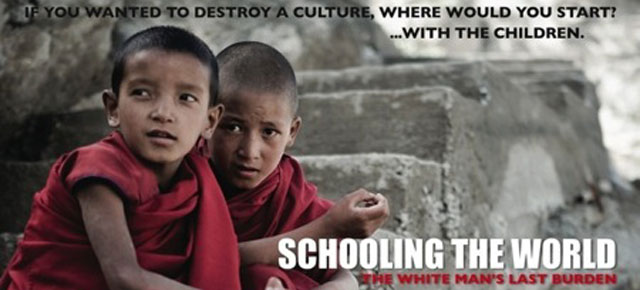
Recently, for a graduate level class Globalization and Curriculum Implications, I was required to watch a documentary titled “Schooling the World: The White Man’s Last Burden”.  Given the class discussion that spurred from the viewing of this film and the tumultuous feelings that it incited within many of my classmates, I felt compelled to share this documentary with the educational community to hopefully to start a conversation around some of the key themes and points that it raises.

A recurring question that appears on the website promoting the film is “If you wanted to destroy a culture, where would you start?…With the children.”[1] The core premise is that formal mass education, as we know it, is destroying the last independent and sustainable indigenous cultures around the world by indoctrinating the young people of these cultures into being members of a global consumer society.[1]  Further, the film’s tagline “The White Man’s Last Burden” brings to light the, often taken for granted, air of superiority that underlies the mission of mostly white, Western nations that are deemed “developed” to carry out education aid projects in developing nations in order to bring them a “better life” and lead them out of poverty.[1]  The spread of formal mass education has not, however, led to lifting the developing world up out of poverty, and the documentary highlights that it would take four planet Earths for the entire world to consume at Western levels rendering much of the “promises” of formal mass education merely an illusion.[2]

What make these realities particularly disheartening are a few facts that the documentary stresses.  First, that governments are acutely aware that education can serve as a tool of control.  For example, in the 19th century, Native American children were forced into government boarding schools, and a founder of one of these schools quoted its mission as being “to civilize the Indians…immerse them in our civilization, and when we get them under…hold them there until they are thoroughly soaked. [1][2] A commencement speaker for this school proclaimed “let all that is Indian within you die.”[2] Further, the filmmakers cite the hierarchy of values that is imposed by formal education.  They talk about an experience common today of traveling into indigenous communities to talk to elders about traditional knowledge and practices, only to have these elders refuse to provide their insight on the grounds that they are not “educated,” or they defer to their children who have now completed formal education to some level. [4]

Not far in the past there were approximately six thousand languages spoken on earth, but today half of these languages are not being taught to children as English is strictly enforced in many schools as the language that rules so many facets of the world.[5] On the grounds of being economically competitive, a particular type of student and subsequently human being is cultivated within the walls of formal mass schooling that destroys human individuality in the process of training students for scarce jobs in an urban consumer environment.[2][3]  Parents cite heartache over the breaking up of their families as they send their children away or see their children moving away with their own children in search of better schooling. [1][2]

Given that my program of study is Comparative and International Education, my classmates are from very diverse backgrounds.  Some are from the United States or of Western origins and are teaching abroad in various settings such as international schools, others are interested in education policy or international development, while others still are teachers within their country of origin.  Regardless of background, each student had a very similar reaction of both being saddened, overwhelmed, and angry at the ways in which formal mass schooling is impacting so many people all over the world.  Further it really led everyone to question and to think about his or her role in this process.

The most common criticism of this documentary by my classmates was that it brings to light many alarming and important points regarding how formal schooling is impacting people, communities, and our relationship with our planet, but it does very little by way of offering any points for action or change.  I personally feel that while the film grounds its argument from the very beginning in an imperialistic view of education, giving the example of Native Americans in the United States, this dynamic is much less overt and much more complicated today.  Formal mass education has become a deeply institutionalized part of daily life all over the world.  It is no longer explicitly imposed on others as a means of control but, rather, is much more frequently willingly agreed to and accepted by those in indigenous or developing communities.  Many of my classmates questioned why these people do not refuse or fight back, why they adhere to this model of formal mass schooling at the expense of their culture, traditions, family units, and their relationships with the environment.  Why do they sacrifice their sustainable ways of life, their independence, for promises that largely continue to go unmet?

One of the central questions to the course for which this documentary was mandatory was “what gets taught in schools and who gets to decide.”  I think the reason that so many people all over the world acquiesce to the idea of mass schooling as it has come to be known is because they do believe that on some level education can be used as a tool for good.  The questions just posed of what gets taught and who gets to decide become of ever greater importance as we think of not whether we should rid the world of mass schooling completely, but of how we can allow it to exist and to grow in a way that is in harmony with the people that it serves, not in a way that destroys them.  The first step, I believe, is for us to engage in a dialogue about how to disrupt the current conceptions and value systems regarding knowledge, learning, and the goals of education to allow for more inclusive definitions.

[1] Schooling the World. (2010). The film. Retrieved from http://schoolingtheworld.org/film/

[2] Schooling the World Part 1/7 [Video File]. Retrieved from https://www.youtube.com/watch?v=XLSIgZWNR9M

[3] Schooling the World Part 2/7 [Video File]. Retrieved from https://www.youtube.com/watch?v=jeZSQTE8RrE

[4] Schooling the World Part 3/7 [Video File]. Retrieved from https://www.youtube.com/watch?v=arzoZqTceic

[5] Schooling the World Part 5/7 [Video File]. Retrieved from https://www.youtube.com/watch?v=V5mm2YtiO0A

Clayton Duong's avatar

Private tutoring in Vietnam: A public concern rather than a private story

The school operates extra classes because the students’ entry level knowledge is far below average and they are actually dumb” Ms. Mai, headmaster of a high school in Hue, Vietnam.

This statement was made earlier this year by an educational administrator who was trying to justify to the inspectors and reporters why her school held extra private lessons, charging students fees during school hours. Either feeling extremely shocked or somewhat empathetic with her explanation, many people have come to realize that this is only one among many reasons for having extra classes in Vietnam. Indeed, private tutoring appears to be indispensable in the context of Vietnam. This has in effect negated the ban on private tutoring for the last two years.

some snacks before the next extra class!

Choosing to confront instead of tolerate private tutoring, Vietnam has taken quite a few measures to tackle the rising scale of private tutoring over the last two decades. In addition to the regulations, the government has stipulated numerous policy documents to curb private tutoring and concomitant illegal financial affairs. Various measures and efforts to control private tutoring have been documented since 1993. In 2012, the country started enacting one of the strictest bans on private tutoring. Sadly, the phenomenon remains pervasive and tutoring practices become largely uncontrollable.

Despite the ban, extra classes in numerous forms continue to grow. The media continues to report cases breaching the private tutoring ban: school administrators violating the ban are fined, tutoring teachers are punished. Ironically, the more regulations introduced, the more teachers provide extra classes, both legally and illegally. The stricter the penalty provisions, the more creative parents and schools become in finding ways to continue the extra classes. While the vicious circle has not been broken, all people involved in this circle seem to feel more guilty. By seeking ways to supplement their salaries and cover the mainstream curriculum, many teachers now feel like criminals. By trying to secure their children the best possible education, most parents feel like accomplices. Worst of all, by attending extra classes to compete the regular curriculum or improve their academic performance, students feel that they are less able and even dumb!

Mark Bray, a scholar who has studied private tutoring for a long time, notes that private tutoring ban has appeared ineffective in most countries that implement it. South Korea has been the most often cited example. Its draconian measure against private tutoring during late 1900s was a complete failure, leading its government to loosen control on private tutoring practices.

Vietnam should learn the ‘private tutoring’ lessons from other countries, no matter whether these lessons are successful or not. It can also learn a lot from different education initiatives that have been introduced in other countries. More importantly, it should open the discussion on the related issues to the wider public, taking both parents’, teachers’, students’, and experts’ opinions. At the same time, more research on private tutoring and related issues in the local settings should be rigorously promoted.

Undeniably, it would take more time and resources to tackle the root causes of private tutoring than simply prohibiting it. I agree with many people saying that private tutoring seems like a chronic ‘disease’. But it’s by no means incurable. It also true that the effects of private tutoring are so serious that it badly needs fixing. But experience shows us that too often, quick medication proves ineffective in the long run and poses unintended effects. In fact, portrayed by the media as being “incompatible”, only “working on paper” or “going into an impasse”, the ban can hardly achieve its goal as a ‘silver bullet’ solution to private tutoring. Undoubtedly, choosing not to ignore private tutoring is a ‘must’. But inappropriate handling of it would run the risk of going against the very direction of the Vietnamese government’s ‘socialization of education,’ which emphasizes the need for “all segments of society” to contribute to the provision of education.

I share the view with the authors of the book ‘Shadow education in Asia’ who state that careful analysis and a great deal consultation need to be sought before implementing any policy. This can include thorough assessment of the current context to understand the supply and demand mechanisms of private tutoring in Vietnam.

Overall, instead of ‘upgrading’ the unworkable ban with new regulations and circulars, it’s high time for Vietnam to revamp the national examinations, which is private tutoring’s number one partner. In addition to reducing the study load at all levels, Vietnam should urgently reform teachers’ salary. Most importantly, it must improve the selection and training of teachers. It is teacher quality in mainstream schools that would gradually change parents’ deep-rooted stereotypes about education quality in public schools and misinformation about private tutoring’s miraculous effects on their children’s achievements.