
Like most searching for an answer, I started by looking at PISA results and commonalities between high performing nations.
My first search: National Curriculums.
It seemed to work well for Japan and New Zealand but not for the UK and Portugal. Time to look for another explanation.
PISA tries to avoid supporting rote memorization by measuring “How well can students nearing the end of compulsory schooling apply their knowledge to real-life situations?” So, maybe countries with strong links to high stakes/standardized testing will reveal poor scores.
No dice. Finland and the Republic of Korea (ROK) are at opposing ends of the testing spectrum. Finland has very little standardizing testing and ROK works towards solely standardized testing. PISA shows both countries in the highest echelon on national education. Next.
Maybe countries with the highest spending on education skyrocket the PISA rankings? Nope…another dead end. The USA ranked the fourth highest in public expenditure on primary, secondary and tertiary education per student by the OECD. Much higher than ALL front runners.
How could this be?
“Currently only 59 cents of every education dollar reaches the classroom. Fewer than half of Washington’s 101,700 public school employees are classroom teachers. Spokane Public Schools employs 3,087 people, one for every nine students, but only 41 percent of them are classroom teachers.”
–Washington Policy Center
So, maybe it’s cultural or political?
“Finnish schools are funded based on a formula guaranteeing equal allocation of resources to each school regardless of location or wealth of its community.
“All children in Finland have, by law, access to childcare, comprehensive health care, and pre-school in their own communities. Every school must have a welfare team to advance child happiness in school.”
“ All education from preschool to university is free of charge for anybody living in Finland. This makes higher education affordable and accessible for all.”
-Washington Post
Now we’re getting somewhere!
One of the most emphasized points in the Finnish system is the social status of teachers and its impact on education.
The OECD states Finnish teachers hold an extremely high social status and one of the most sought after professions. Teachers are taken from the top 10% of gradates to earn a masters in education before being able to teach in public schools.
Conversely, consider the U.S. stigma of teaching: “Those you can’t do, teach.” “Easy job, short hours with major vacation time” isn’t the reality. Again in OECD comparisons:
-Finnish teachers are paid substantially lower than their American counterparts.
-U.S. teachers put in 1051 hours of direct teaching with Finland, a mere 550.
In Hidden Markets (2007), Patricia Burch shows the further decline of the status of American teachers showing a cultural shift towards online learning. Public state funds are already being used as an alternative to public schools. In some states it is even possible for virtual schools to hire non-certified and non-full time staff.
To me it needs to be a ‘one problem at a time’ approach. The initial focus needs to be on providing an education as opposed to the cost cutting measures limiting it. The Federal and State governments haven’t mastered the application before attempting to sell it off as a commodity and stripping it of the biggest strengths. Teachers.
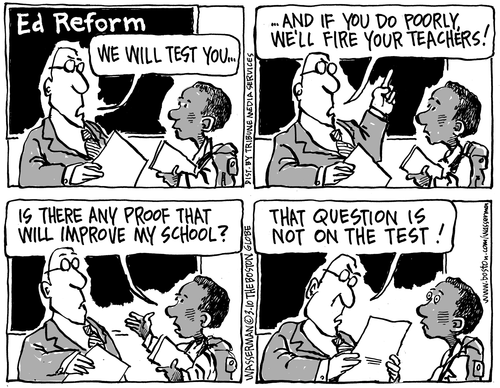
U.S. teachers are paid a low salary comparative to other college graduates, are readily being replaced by computers and online classrooms, work longer than teachers in other countries, are forced to submit to standardized testing in a very non standardized environment and with society assuming ‘they have it easy.’
Maybe a consultant will suggest we ‘stop trying and fail for free?!?’

 Education Policy Talk